We bring the question to the data. And why.
Tune Insight started out as a privacy tech company. We spent about ten years building federated analytics with Swiss university hospitals, and for a long time we tried to sell it to anyone with sensitive data, including banks, insurances, and cybersecurity providers.
We’ve stopped doing that. We identified a major need and now work for pharma, BioTech, MedTech and CRO teams who need real-world evidence from European hospitals, and nothing else. This post is our attempt to explain the change in plain language, including the parts we haven’t figured out yet.
Where the time actually goes
This month we sat down with RWE, value evidence and market access people from big pharma companies in a pan-European market research focus group, and walked them through the Tune Insight RWE platform. We expected to talk about analytics. Mostly we talked about waiting.
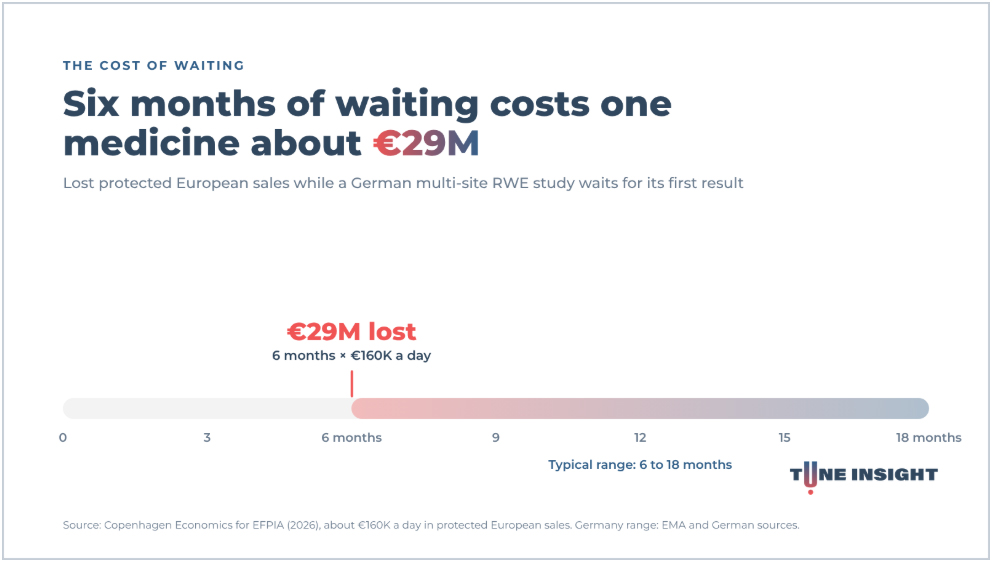
Waiting for contracts, for approvals, for data to be extracted, cleaned and shipped somewhere else. In Germany a multi-site RWE study typically takes 6 to 18 months before anyone sees a first result. One person told us that contracting with hospitals alone can take anywhere from six months to two years. The EMA has seen the same thing in its own work: studies it bought through framework contracts took a median of 25 months (EMA).
That delay has a hefty price. A protected medicine earns roughly €160,000 a day in Europe before generics arrive (Copenhagen Economics for EFPIA, 2026). Now take the low end of that German range. If a six-month study sits on the path to launch or reimbursement, those six months come straight off the product’s protected sales: roughly €29M in lost European revenue for a single medicine.
What we mean by federated
We say “federated” a lot. In the interviews it was the word people understood least, which was a useful wake-up call. Jeremy, who leads our sales team, said we should explain it the way we’d explain it to a friend. Fair enough.
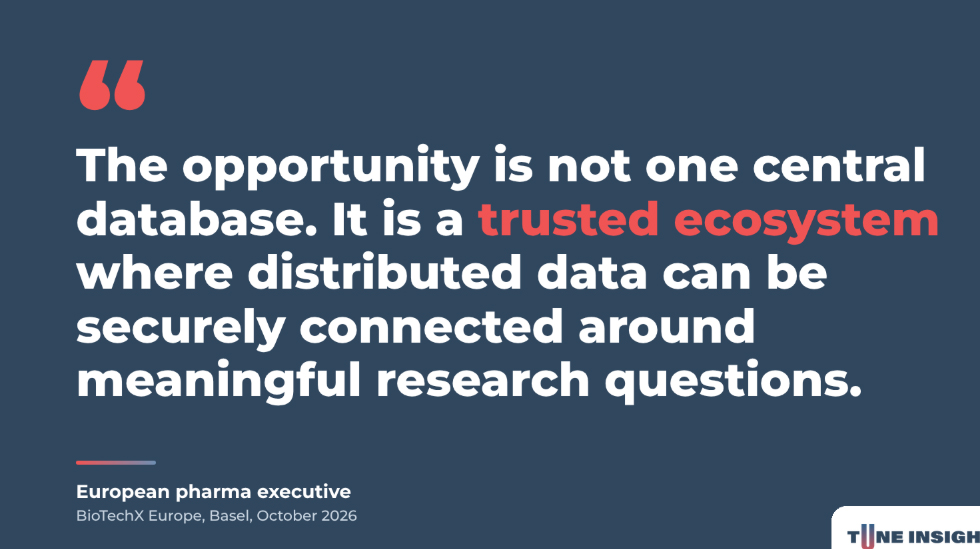
The usual way to do RWE is to copy hospital data into a central database and sell access to it. Building that copy takes months, and holding it is a liability. Each hospital you want data from needs its own data transfer agreement. Then the records get extracted, mapped and cleaned, and by the time they land in someone else’s warehouse they’re already months out of date. And once the data has moved, whoever holds the copy must protect it and carries the risk if it leaks, while the hospital has lost control of records it is still legally responsible for. We’re not the only ones who think the central copy is the problem. At BioTechX Europe in Basel last month, a senior pharma executive put it this way:
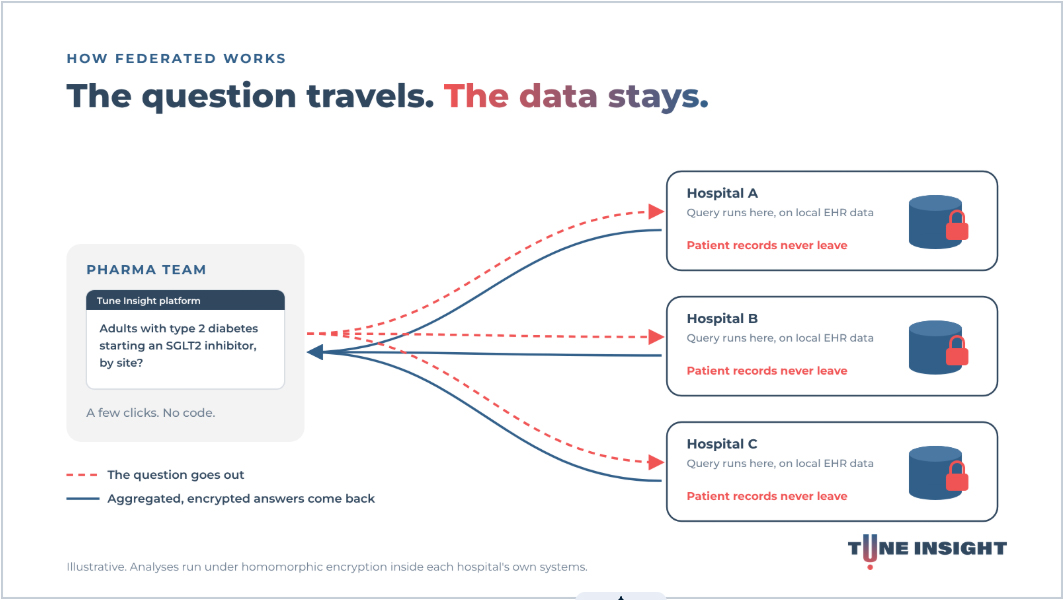
Instead, we don’t copy anything. The data stays in the hospital and the question goes to it:
- The hospital keeps its records on its own systems, pulled from its EHR, mapped to a standard format (OMOP) and kept up to date.
- They get the added benefit of having the data structured, cleaned and made pharma-ready, which can generate precious revenue for them.
- Someone on a pharma team asks a question. Say, how many adults with type 2 diabetes started an SGLT2 inhibitor in the last 12 months, broken down by site. Or they’re choosing sites for a study and want to know which hospitals actually see enough of those patients.
- They type that question, or set up that test, in the Tune Insight platform. It takes a few clicks, no code and no data science team. The query then runs on the data where it already sits, inside each hospital’s walls.
- What comes back is aggregated and encrypted. Patient records never leave. There’s no raw export.
One interviewee was surprised by that, because he wanted patient-level files to feed his own models. We understand why, but it’s a deliberate choice. The pharma company never holds patient data, so it never has to worry about it. That lowers the legal, reputational and breach risk for everyone involved. It also cuts out most of the legal orchestration complexity. Instead of negotiating a data transfer agreement (DTA) with every hospital, there’s one pre-negotiated framework contract for multi-site contracting. For a team running two multi-site studies a year, we estimate that saves up to €300k in legal and contracting costs. And the hospital stays in control, which is the main reason hospitals agree to partner with us at all.
Federated analytics has been discussed in research circles for years. What’s been missing is a version fast enough for real study timelines, secure enough for hospitals to say yes, and simple enough that a pharma team can use it without a data scientist. That’s what we’ve spent the last decade building. It already runs in Switzerland’s Personalized Health Network (SPHN), with information on almost one million patients and more than 16 billion machine-readable data statements, and powers half-a-dozen other federated networks, including National AI Initiative for Precision Oncology, which links 11 hospitals with pharma partners including Roche and Debiopharm.
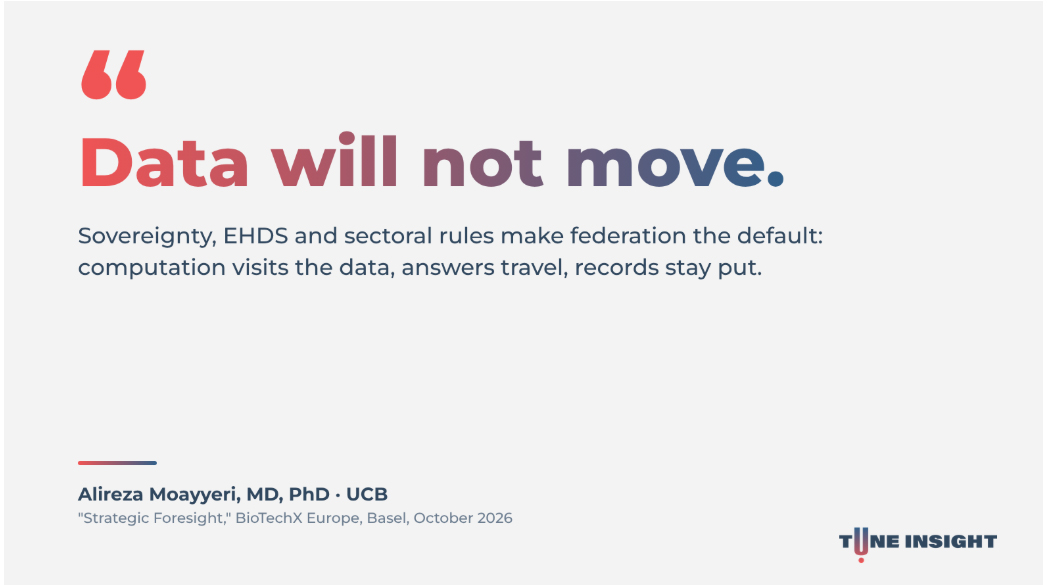
Where is this heading? In his BioTechX talk on prioritising AI in real-world evidence, Alireza Moayyeri of UCB listed three conclusions about 2030. The first one was four words long:
What we got wrong
Some of the feedback stung. A few points changed how we talk about the product.
Speed won’t carry us on its own. A former RWE lead at a big European pharma company was blunt about it: speed gets you a meeting, data quality decides whether you get the contract. For RWE teams, quality mostly comes down to which variables are there and how much is missing. If a biomarker is missing for 80% of patients, you want to know before you design the study, not halfway through. So the platform now shows data coverage by domain and by site before you commit, and the answer becomes go, no-go, or adapt the design.
Representative datasets matter more than big datasets. Representativeness matters even more as medicine gets more targeted. Broad blockbusters are giving way to therapies for smaller, precisely defined groups of patients. Our Head of Growth, Susan Wacklin, summed up what that means for evidence:
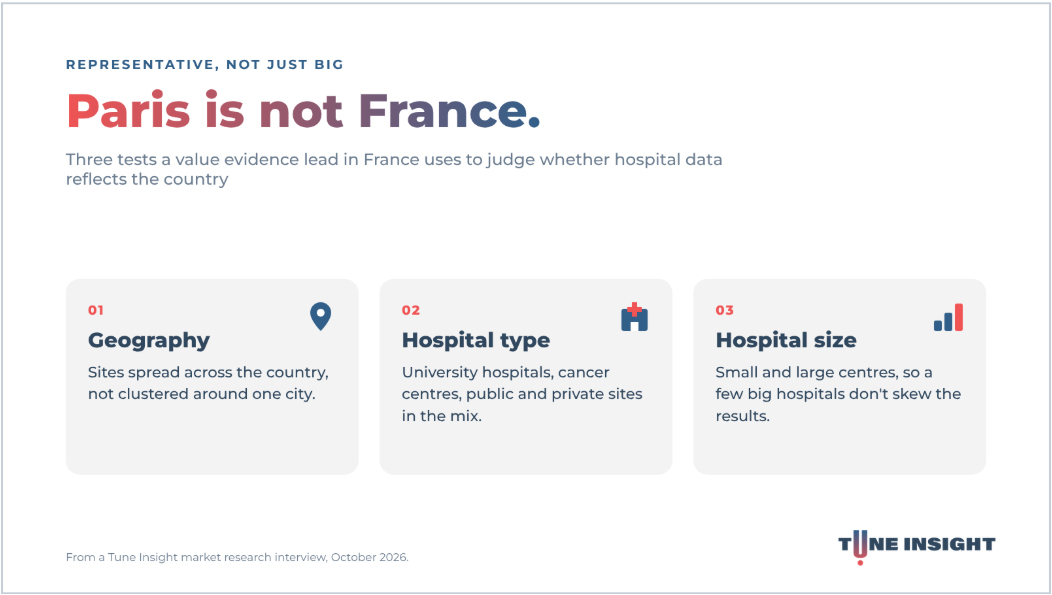
A value evidence lead in France gave us his checklist: spread across the country, a mix of hospital types (university, cancer centres, public, private) and a mix of sizes, so a handful of large centres don’t skew the results. Or as Jeremy put it, Paris is not France. That mix is how we’re building the network.
We were using our own vocabulary. We called patient and site scoping “pre-feasibility”. Most of the people we spoke to don’t use that word, and one used “feasibility” to mean something completely different. So we’re dropping the jargon and starting with whatever question the person actually needs answered.
What we bring
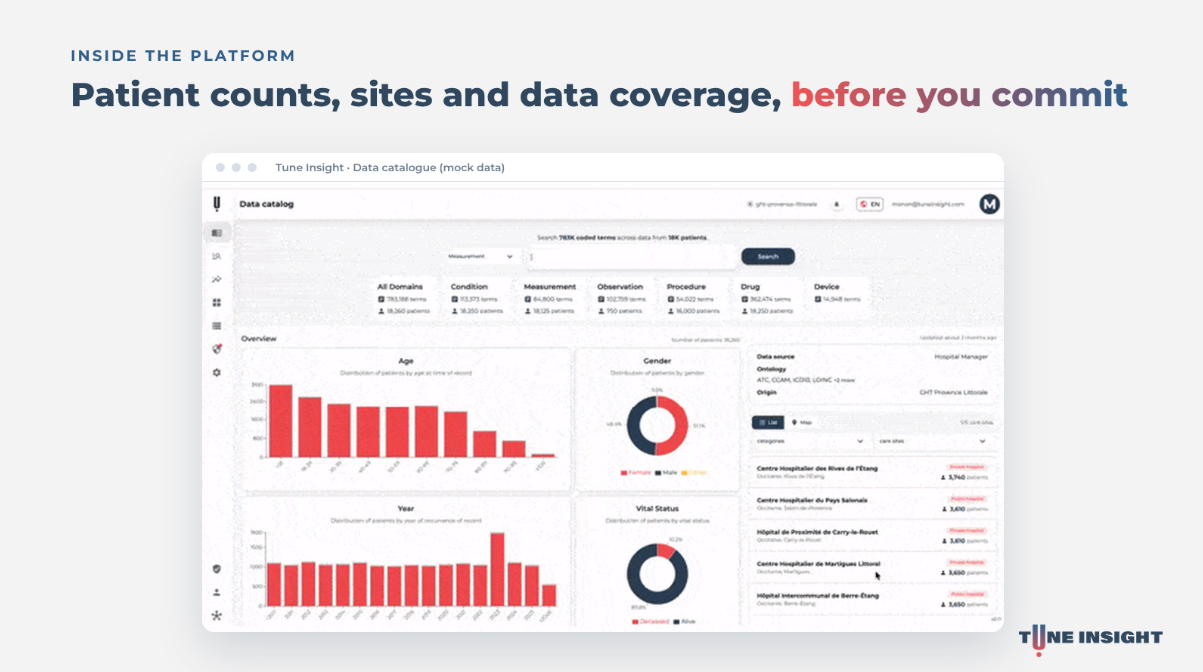
European. The data comes from European hospitals and European patients, which is what the EMA and national HTA bodies actually look at. Today that’s 4 French hospitals and about 475,000 patients. Another 10 hospitals are being connected, which will take us to roughly 3 million patients across France and Switzerland.
Fast. Once a hospital network is live, a query comes back in under a minute. Governance and contracts are negotiated up front, so a multi-site study runs on one contract instead of twenty.
Fit for purpose. Clean, structured hospital data from a mix of public and private sites, mapped to OMOP. The analysis pipeline runs on data refreshed daily, and the site selection catalogue updates weekly. For comparison, national claims databases in France and Germany are often up to two years behind. Nobody in the interviews needed prompting to bring that up.
Federated. Analyses run where the data sits, under homomorphic encryption. We’re ISO/IEC 27001 certified, our site selection catalogue is CNIL-approved, and we hold the EUCROF GDPR Code of Conduct compliance mark. The platform deploys on-premise, hybrid or in a sovereign cloud, and it’s built for the European Health Data Space.
What we’re not saying
The same former RWE lead gave us the best advice we heard all month: “Sell what you have. Be very transparent with what you don’t have.” So, to be clear:
- “Under a minute” is how long a query takes on a live network. It isn’t how long a study takes. You still write and approve a protocol.
- In France, any analysis that touches patient data waits for a 30-day patient notice period. That’s the same for everyone. The difference is what comes next: others usually spend another month or more negotiating contracts, while our contracts are already in place, so you can run your analysis on day 31.
- We don’t cover all of Europe yet. We’re live in France and adding Switzerland. The patient numbers above are what’s connected now, not a forecast.
- Every euro figure in this post comes from a published European source. We’ll publish the workings so you can check them yourself.
Fresh data, fresh smoothies
If you walk past our booth, you’ll see two lines on the walls: “European data. Not American.” and “This morning’s data. Not last year’s.” They’re meant to start a conversation, so here’s what we mean. We have nothing against US data. It’s the benchmark for speed and scale. But a European launch gets judged by European regulators and HTA bodies on European patients, and a big US dataset is no substitute for that. Build European decisions on someone else’s patients and, in the end, European patients are the ones less well served. So we do European data the European way: from European hospitals, under European rules, with the data staying where it belongs. The second line is about time. If the data behind your decision is a year or two old, you’re deciding on a world that’s already moved on.
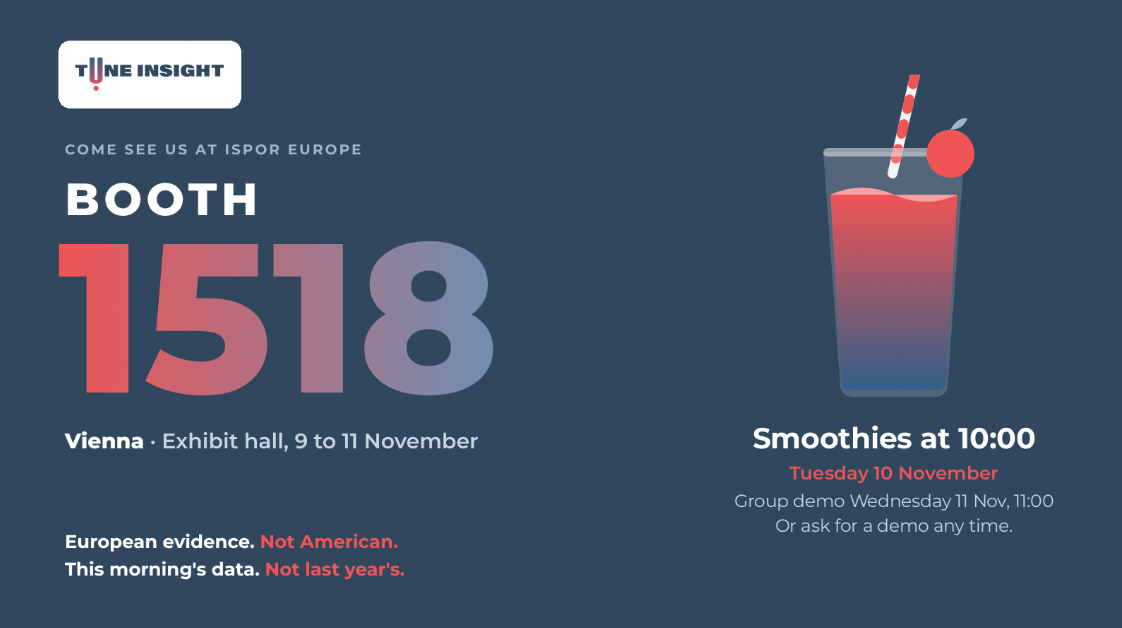
We’ll be at ISPOR Europe in Vienna, 8 to 11 November, at booth 1518. Bring a real question from your pipeline. If we can answer it, we’ll run it in front of you. If we can’t, we’ll tell you why.
To make sure we have time for your question, book a demo slot here: odoo.tuneinsight.net/ispor-2026.
Real-world evidence for real-world impact.